South Africa has a way of confronting you long before you are ready.
Its mountains and oceans pull you in. Its cities hum with ambition. Its people speak with a directness that leaves little room for pretence. Yet beneath the beauty and the confidence lies a country wrestling with questions that cut to the bone.
I had visited many times before, but this visit felt different. The national conversation had sharpened. Community protests, political speeches and social media campaigns had turned migration into one of the most emotionally charged issues in public life.
Many South Africans believed foreign nationals were taking jobs, increasing crime and placing pressure on already strained services. Many foreign nationals felt they had become convenient targets for frustrations rooted in deeper structural problems.
The tension was not imagined. South Africa remains one of the most unequal countries in the world, according to the World Bank.
Youth unemployment regularly sits above forty per cent under the expanded definition. In such conditions, public anger does not float freely. It looks for a target.
It was in this climate that I travelled to Cape Town to see Professor Wole, an old student of my father from the University of Ibadan. He now lectured in Political Economy at the University of Cape Town. The timing could not have been more relevant.
The following afternoon, I joined him for a student discussion organised by the Political Science department. The lecture hall was full. Students filled every seat. Some were final year undergraduates preparing to enter a difficult job market. Others were postgraduate students trying to make sense of a country that felt increasingly uncertain about its future.
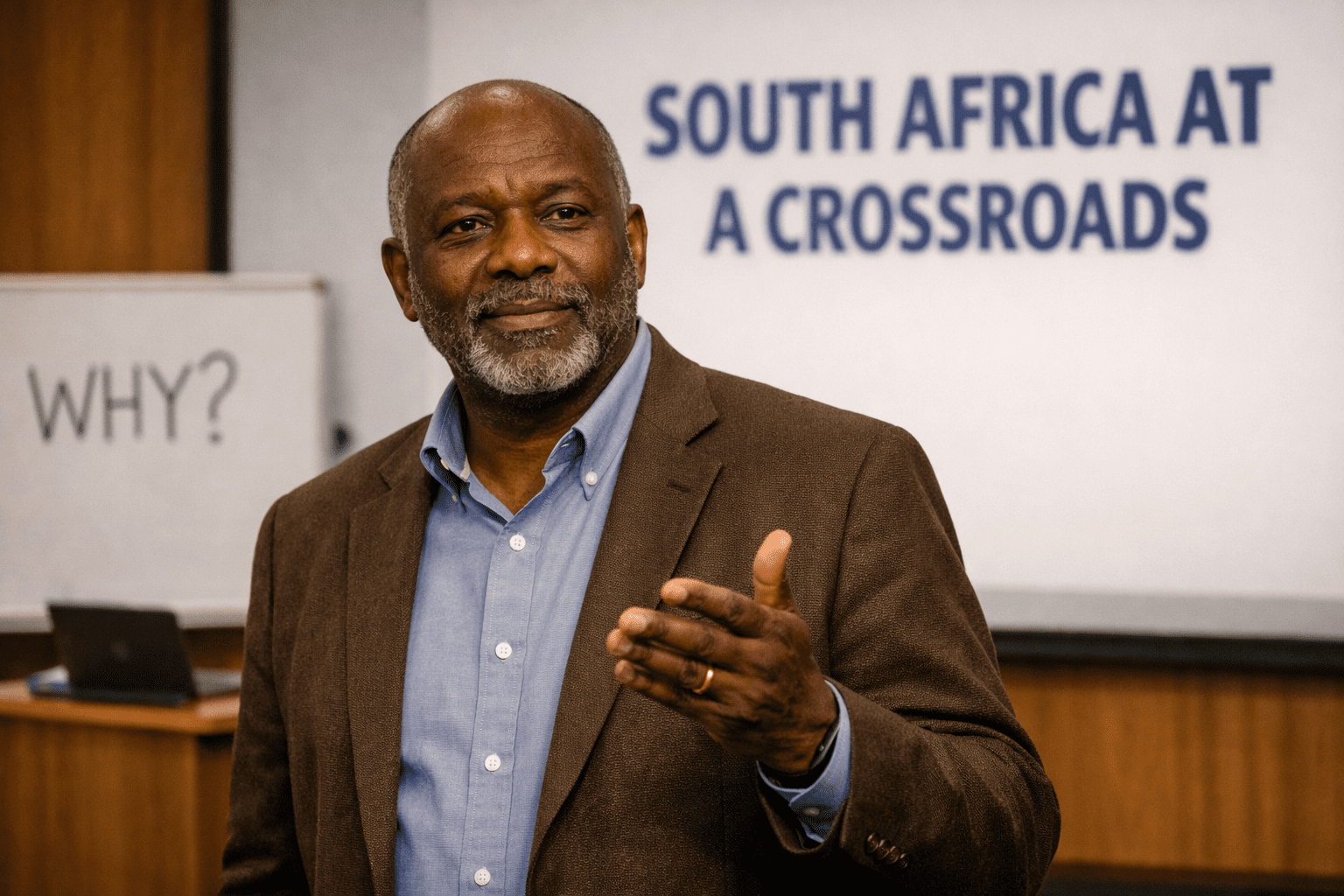
A projector screen displayed the theme for the day.
SOUTH AFRICA AT A CROSSROADS
Professor Wole opened the session with a simple invitation. “Today, I want your questions.”
The first hand rose immediately. Sipho Dlamini, a final-year student from KwaZulu-Natal.
“Professor, why are so many South Africans angry?”
The room held.
“What do you mean?” the professor asked.
Sipho did not hesitate.
“Angry at foreigners. Angry at government. Angry at employers. Angry at the economy. Angry at everything.”
Laughter rippled across the room. The professor smiled. “Fair enough.”
Before he could continue, another voice joined in. Naledi Mokoena from Gauteng. “Many people feel foreign nationals are taking opportunities that should belong to South Africans.”
Several heads nodded.
Another student raised his hand. Thabo Nkosi. “They say foreigners run businesses while South Africans struggle to survive.”
A murmur of agreement followed.
Then came Zanele Khumalo. “They say foreign nationals are responsible for crime.”
The discussion was no longer theoretical. It had become personal.
Then a voice from the back cut through the room with a sharper edge. “Professor, with respect, we hear structural explanations every year. Meanwhile, we are unemployed now.”
The room shifted. This was the tension beneath the politeness.
Professor Wole listened without interruption. When the room finally settled, he walked to the centre of the hall and asked a question that changed the entire atmosphere.
“If every foreign national left South Africa tomorrow morning, what happens on Monday?”
No one responded.
“Would unemployment disappear?”
Still nothing.
“Would corruption disappear?”
The room stayed still.
“Would power cuts disappear?”
Not a sound.
“Would inequality disappear?”
The hall was motionless.
“This,” he said, folding his arms, “is where serious analysis begins. A nation facing economic hardship often searches for someone to blame. The harder task is understanding why the hardship exists in the first place.”
He walked to the whiteboard and wrote one word.
WHY
“The most important question in political economy is not who. It is why.”
He explained that South Africa’s unemployment crisis did not begin with migration. It was rooted in an economic structure built over generations of exclusion and unequal access.
It determined who owned land, who accessed quality education, who accumulated wealth, who built businesses and who passed opportunity from one generation to the next.
“The legal system of apartheid ended in 1994,” he said. “The economic consequences did not disappear in 1994.”
He paused, then added, “South Africa’s inequality is not a historical footnote. It is a present-day structural reality.”
A student near the front raised her hand. “Are you saying nothing has changed since apartheid?”
“No,” he replied. “A great deal has changed. Political rights expanded. Millions gained access to housing, electricity and education. A Black middle class emerged. Democratic institutions were established. But political change and economic transformation do not always move at the same speed.”
Another student asked, “What does Mandela have to do with this?”
The professor smiled. “Everything. How many of you have read Mandela’s writings?”
Only a few hands rose. “That is part of the problem.”
The room laughed, then quietened as he continued.
“Mandela understood the difference between political freedom and economic justice. He understood that reconciliation was necessary for peace, but reconciliation alone could not undo centuries of economic exclusion. For Mandela, reconciliation was never the end of transformation, but the condition that made it possible.”
Then a student at the back asked the question that silenced the hall.
“If Mandela were alive today, would he be happy with South Africa?”
The professor paused. “No serious historian can answer that question.”
The student looked disappointed.
“But I suspect Mandela would ask a different one.”
The room waited.
“After thirty years of democracy, are South Africans spending more time understanding their problems or arguing about who to blame for them?”
The hall was completely still.
For the first time that afternoon, the debate stopped. The students sat quietly, thinking.
Perhaps the question confronting South Africa was not whether foreigners should stay or leave. Perhaps the deeper question was whether the country had fully confronted the economic and historical realities that continue to shape the lives of millions.
When the session ended and the students began to gather their belongings, I walked down to the front to thank the professor. He was packing his notes with the calmness of a man who had carried this conversation for many years.
I hesitated, then asked the question that had been troubling me long before I arrived in Cape Town.
“Professor, why is history so distorted in the curriculum? And what are people like you doing to elevate the mind of society? There is a wide gap between knowledge and reality.”
He looked at me for a long moment. Then he gave an answer I was not prepared for.
“When you have caged a lion in your garden for your own purpose,” he said quietly, “do you show that lion the way to the jungle?”
I stood there, unsure how to respond.
He continued. “Those who benefit from a society’s confusion rarely invest in its clarity. A population that understands its history becomes harder to manipulate. A population that can think becomes harder to control. So, the lion is kept in the garden. Fed enough to survive. Starved enough to stay weak. And always kept far from the path that leads back to the wild.”
I slept on his words that night. By morning, I understood him perfectly.
He was not speaking about lions. He was speaking about people. He was speaking about the deliberate thinning of historical memory. He was speaking about the quiet fear that sits inside every unequal society. The fear that the moment people understand the truth of their condition, they will refuse to accept it.
And he was speaking about the responsibility of those who teach. Not to tame the lion. But to remind it that it was born for the jungle.
South Africa’s challenge is not only political. It is how a society explains itself to itself.
The country does not need more blame. It needs more truth. It needs more courage. It needs more people willing to ask the questions that silence a room.
Because sometimes the most powerful step a society can take is not to find the right answer.
It is to finally ask the right question.