
Two weeks.
That was all the time they had left.
Peter thought about it as he drove away from the school gates after dropping off Ola and Ayo that morning.
The boys disappeared through the entrance without a care in the world.
Ola was discussing homework with his friends.
Ayo was already talking about football.
Peter smiled briefly.
Children measured life differently.
They did not count visa deadlines.
They did not calculate sponsorship costs.
They simply lived.
The smile disappeared as he pulled away from the school.
Two weeks.
The number refused to leave his mind.
When he arrived home, Sola was already in the kitchen.
She was off duty that morning.
The kettle had just boiled.
Neither of them spoke immediately.
There was little left to discuss.
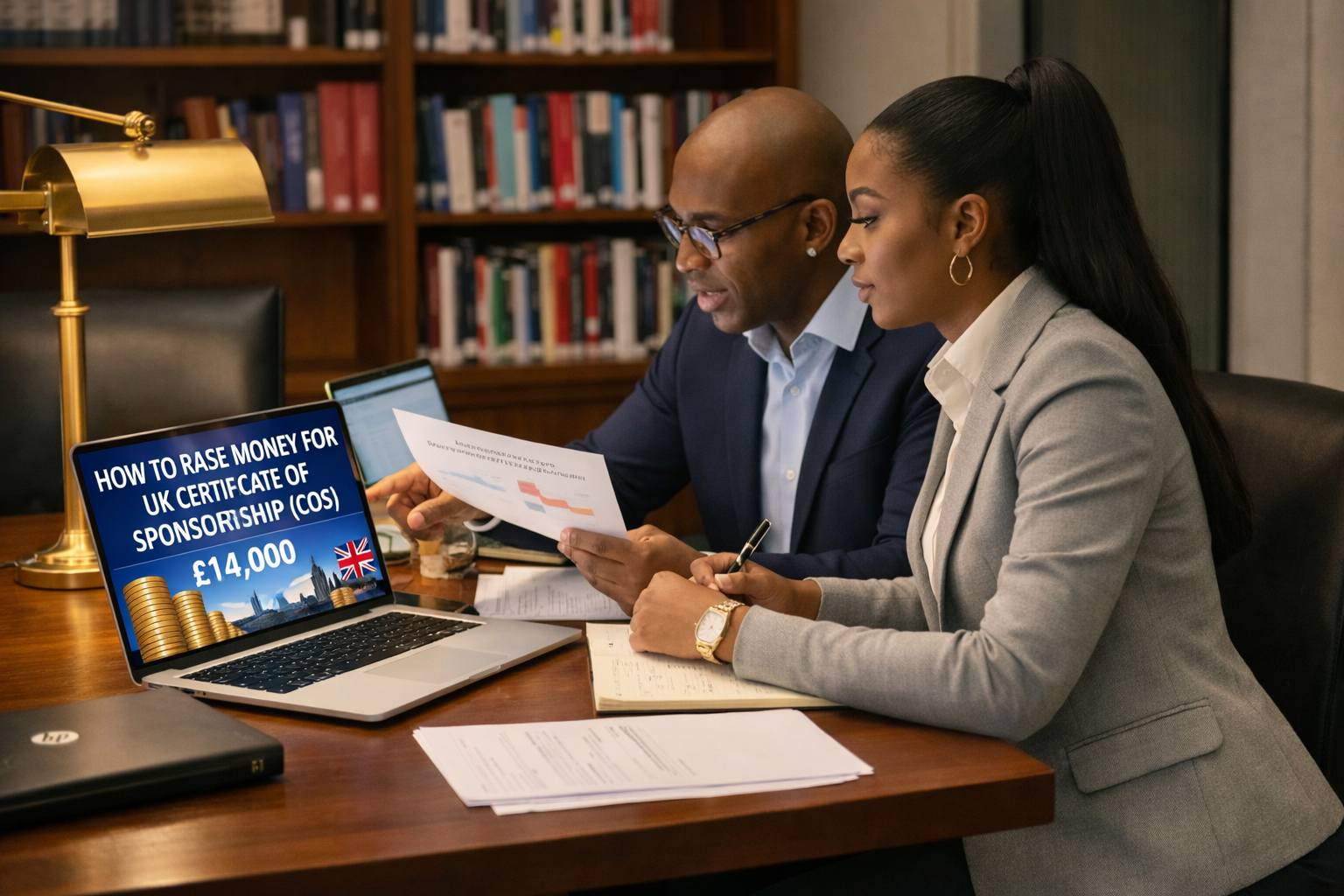
For days, the dining table had looked more like a planning office than a family dining room.
Bank statements.
Savings records.
Visa documents.
Handwritten calculations.
Notes from solicitors.
Every sheet of paper pointed towards the same figure.
£14,000.
The amount no longer shocked them.
In recent months, they had heard figures far worse.
What worried them now was something else.
Value.
If they were going to spend £14,000, they wanted to spend it wisely.
Sola placed two cups of tea on the table.
Peter sat down.
The notebook containing their calculations remained open.
For the first time since their immigration problems began, they were actually close to raising the money.
Sola’s parents had agreed to contribute £5,000 from Nigeria.
It was a significant sacrifice.
Peter knew that.
His brothers in Canada and Texas had also promised support.
Combined with their savings, the gap had narrowed considerably.
Only about £5,000 remained.
It was still a large amount of money.
But compared to where they had started, it felt achievable.
Peter looked down at the figures.
Migration, he realised, had become a family project stretching across three continents.
The people helping them would never appear on any visa application.
Yet without them, survival would have been impossible.
His phone rang.
Tunde.
Peter answered immediately.
“Good morning.”
Tunde’s voice sounded unusually excited.
“Are you at home with your wife?”
Peter frowned.
“Yes.”
“Put me on speaker.”
Peter pressed the button and placed the phone on the table.
Sola moved closer.
“What happened?” she asked.
Tunde laughed.
“I think I’ve found something better.”
Peter sat upright.
Better.
That was a dangerous word.
Over the past few months they had learned not to trust optimism too quickly.
“What do you mean?” Peter asked.
“The COS.”
The room immediately became quiet.
Tunde continued.
“The one you were planning to take.”
Peter nodded.
“Yes.”
“It comes with sponsorship.”
“But not guaranteed work.”
“Exactly.”
That had been their biggest concern.
Some survived by relying on agency work, but shifts were never guaranteed. Many struggled to secure even twenty hours a week. Under such arrangements, paying rent and meeting basic living costs became a constant challenge.
Tunde lowered his voice.
“A Nigerian-owned care home in Kent has become available.”
Neither Peter nor Sola interrupted.
“They need staff, but they’re also charging for the sponsorship.”
“The sponsorship is genuine.”
“The job is genuine.”
“And Sola would receive a forty-hour contract.”
Peter looked towards his wife.
She looked back at him.
For several seconds, nobody spoke.
Forty contracted hours a week.
Not promises.
Not possibilities.
Not future discussions.
Forty contracted hours.
Guaranteed.
The difference was enormous.
Tunde continued.
“And as I said, they’re charging for the sponsorship.”
“The cost is the same.”
Peter blinked.
“The same?”
“£14,000.”
The kitchen fell silent.
Peter leaned back slowly.
For weeks they had prepared themselves to spend £14,000 on a sponsorship that carried uncertainty.
Now someone was offering a sponsorship with an actual job attached.
It almost sounded too good to be true.
“Are you sure?” Sola asked.
“As sure as I can be.”
“The owner is Nigerian.”
“The care home is operating.”
“The vacancy exists.”
“And they’re looking to move quickly.”
Peter glanced at the calendar hanging on the wall.
Two weeks.
The timing could not have been tighter.
After the call ended, neither he nor Sola spoke immediately.
The opportunity they had been praying for appeared to be standing directly in front of them.
The challenge now was finding the final £5,000.
Peter stared at the notebook.
For months, every door had seemed to close.
For the first time in a very long while, one appeared to be opening.
The question was whether they could get through it before time ran out.
For the first time in months, Peter and Sola allowed themselves a moment of relief. They embraced quietly, reassuring each other that perhaps things would work out after all.
The following morning felt different.
For the first time in weeks, Peter woke up with something resembling optimism.
Not certainty.
Not confidence.
Just enough hope to get through the day.
After breakfast, he and Sola sat together in the living room waiting for two important calls.
One from the solicitor.
The other from the care home manager in Kent.
The previous evening had passed in a blur.
A genuine sponsorship.
A genuine vacancy.
A guaranteed forty-hour contract.
The opportunity still felt almost unreal.
Shortly after ten o’clock, Sola’s phone rang.
The care home manager.
She immediately placed the call on speaker.
The manager spoke calmly.
“We’ve discussed your situation.”
Peter exchanged a glance with Sola.
The manager continued.
“We understand that raising this amount of money takes time.”
Neither of them interrupted.
“The owner is prepared to accept an initial payment of £9,000.”
Peter sat upright.
Sola’s eyes widened.
“The remaining balance can be paid later.”
“Within two weeks?” Peter asked.
The manager paused.
“We can be flexible.”
“A month at most.”
For several seconds, nobody spoke.
The words hung in the room.
£9,000.
They already had that.
The remaining £5,000 would still need to be raised.
But the immediate pressure had suddenly eased.
When the call ended, Peter leaned back into the sofa.
For the first time in months, he felt the tightness in his chest loosen.
Sola smiled.
“We can do this.”
Peter nodded slowly.
“We actually can.”
The numbers finally made sense.
Her parents had already committed £5,000.
His brothers in Canada and Texas had promised support.
Their own savings filled part of the gap.
What had looked impossible only days earlier now appeared within reach.
The solicitor called shortly afterwards and confirmed that once the initial payment was made, preparations for the application could begin.
When the call ended, the house felt lighter.
Neither Peter nor Sola noticed how long they sat there smiling.
Not because the battle was over.
Because, for the first time, they could see a path through it.
Then came a knock at the door.
Peter frowned.
They were not expecting visitors.
A second knock followed.
He stood up and walked towards the entrance.
When he opened the door, he froze.
Tunde stood outside.
Beside him was Pastor Ade.
Peter smiled immediately.
“Pastor.”
The pastor returned the smile.
“Good morning, Peter.”
Tunde stood quietly beside him.
“Can we come in?”
Peter stepped aside.
“Of course.”
A few moments later, everyone was seated in the living room.
After a brief prayer, Pastor Ade reached into a folder he had been carrying.
Peter assumed it contained church documents.
Instead, the pastor placed several sheets of paper on the coffee table.
Bank transfer confirmations.
Peter looked confused.
The pastor smiled.
“Tunde told the men’s fellowship about your situation.”
Peter immediately turned towards Tunde.
Tunde smiled.
“I wanted it to be a surprise.”
Peter frowned.
“What situation?”
“The sponsorship.”
“The visa deadline.”
“The pressure you’re carrying.”
The room became quiet.
Pastor Ade gently pushed the documents towards him.
“The men decided they wanted to help.”
Peter looked down at the figures.
Then looked again.
£5,000.
Raised by members of the church.
Raised by men who had listened to his story.
Raised by people who expected nothing in return.
For several seconds, Peter could not speak.
He adjusted his glasses.
Then removed them completely.
The room became blurry.
Not because of his eyesight.
Because his eyes had filled with tears.
For years he had been the person people approached when they needed help.
For years he had solved other people’s problems.
Now, without asking, an entire community had quietly gathered around his family.
At that moment, Peter understood something he would never forget.
Sometimes survival was not about individual strength.
Sometimes it was about allowing yourself to be carried.
The Trap Continues…



I definitely cried with Peter here 🥹
Tunde is such a friend in need and indeed!
Absolutely