
By Oliver Grant
Why Are Some Ethnic Communities More Likely to Live in Poverty?
The latest figures reveal stark inequalities across Britain’s ethnic communities. But while the statistics are clear, the reasons behind them are far more complex than many public debates suggest.
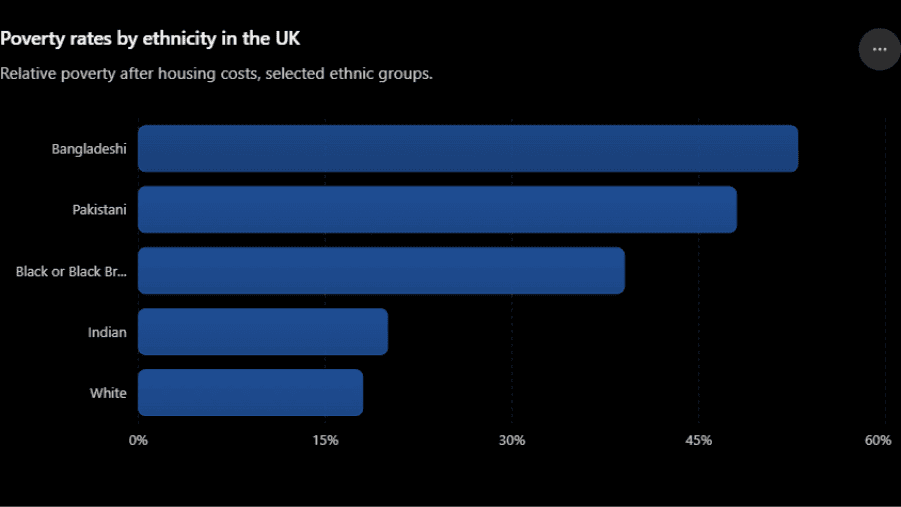
According to the latest analysis by the Joseph Rowntree Foundation (JRF), 53% of people in Bangladeshi households live in poverty after housing costs, compared with 48% in Pakistani households, 39% in Black or Black British households, and 18% in White households. The figures expose one of Britain’s most persistent inequalities, but they do not answer the most important question: why?
That question matters because Britain remains one of the world’s largest economies, yet millions of people continue to struggle to afford basic necessities. Understanding why poverty affects some communities more than others is essential if policymakers hope to reduce inequality.
The data reveals a pattern, not a cause
Statistics tell us who is poor, but they do not explain why poverty exists.
It is tempting to search for a single explanation, whether discrimination, immigration or welfare dependency. However, the evidence suggests no single factor explains the disparity. Instead, poverty is shaped by a combination of labour market conditions, housing costs, wealth, migration history, family circumstances and public policy.
Just as importantly, not all ethnic minority groups experience poverty at the same rate. Indian and Chinese households record considerably lower poverty rates than Bangladeshi, Pakistani and Black African households. That alone suggests ethnicity, by itself, cannot explain the differences.
Employment no longer guarantees financial security
For generations, work was viewed as the surest route out of poverty. Increasingly, that assumption no longer reflects reality.
The rise of working poverty means many households remain below the poverty line despite having one or more people in employment.
According to the JRF, 37% of Bangladeshi workers and 32% of Pakistani workers experience in-work poverty. The organisation also cites research from the Trades Union Congress showing that 18% of Black and minority ethnic workers were in insecure employment in 2022, compared with 11% of White workers.
Many ethnic minority workers are concentrated in sectors such as hospitality, social care, transport, warehousing and retail, industries that often offer relatively low pay, insecure contracts and limited opportunities for progression.
Housing and wealth widen the gap
Income tells only part of the story.
Housing costs play a decisive role because UK poverty is measured after housing costs. Communities concentrated in London, Birmingham and Manchester face significantly higher rents and living expenses than households elsewhere.
Wealth is an equally important, though often overlooked, factor.
Government data shows that 70% of White British households own their homes, compared with 68% of Indian households, 55% of Pakistani households, 37% of Bangladeshi households, and substantially lower rates among Black households in England.
Home ownership remains the principal source of wealth for most British families. Those without property are more vulnerable to rising rents and have fewer assets to cushion financial shocks.
Migration history influences opportunity
Britain’s ethnic communities did not all arrive under the same circumstances.
Some migrated through skilled employment routes, bringing recognised qualifications and financial resources. Others arrived as refugees, asylum seekers or family migrants, often beginning with few assets and facing challenges in getting overseas qualifications recognised.
These different starting points continue to influence employment opportunities, income and wealth decades later.
Migration history does not determine poverty, but it helps explain why economic outcomes differ between communities.
Discrimination remains part of the picture
Research continues to show evidence of discrimination in recruitment, promotion and earnings.
Applicants with ethnic sounding names have been shown in several studies to receive fewer interview invitations than equally qualified applicants with traditionally White British names.
However, discrimination alone cannot explain the full picture.
If it did, all minority communities would experience similar poverty rates. The evidence instead suggests discrimination interacts with other structural factors rather than replacing them.
Poverty is becoming more persistent
Perhaps the most worrying finding is not simply who is poor, but how long they remain poor.
The JRF reports that 11% of people in Bangladeshi households, 9% in Pakistani households and 8% in Black African households experienced persistent very deep poverty between 2011 and 2023, compared with 2% of people in White households.
Persistent poverty affects educational attainment, health outcomes, employment prospects and social mobility, making it far harder for future generations to escape financial hardship.
Beyond the statistics
The latest figures should not be viewed as a verdict on any community. Rather, they reveal how economic opportunity remains unevenly distributed across British society.
The evidence suggests there is no single explanation for Britain’s ethnic poverty gap. Instead, it reflects the interaction of labour market inequality, housing affordability, wealth accumulation, migration history, family circumstances and discrimination.
Understanding that complexity is essential. Policies based on simplistic assumptions are unlikely to solve a problem rooted in decades of structural inequality. The statistics tell us where the disparities exist. The challenge for Britain is to understand why they persist and to design policies capable of narrowing the gap.

Oliver Grant is a British journalist based in London, known for his calm insight, clear storytelling and thoughtful approach to social affairs, politics and culture. His work combines investigative depth with human-centred reporting, exploring the issues that shape communities and public life. Through digital and broadcast platforms, Oliver brings a balanced perspective to complex subjects, championing journalism that informs, challenges and encourages meaningful conversations.