
By Oliver Grant
More than two years after leaving LBC, journalist and broadcaster Sangita Myska has spoken publicly about the circumstances surrounding her departure, reopening questions about editorial independence, journalism and the limits of challenging powerful institutions.
What Myska says happened
In an interview published by Double Down News on 11 August 2026, Myska revisited her departure from LBC following her April 2024 interview with Israeli government spokesperson Avi Hyman.
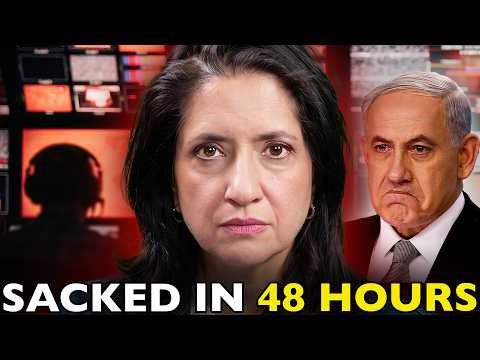
The interview was published under the headline, “I Questioned Israel: 48 Hours Later I Was Sacked.” Myska said that after interviewing Hyman, she was told within 48 hours that she was no longer on air and that she was subsequently described as “surplus to requirements”.
THE ISRAEL INTERVIEW MEDIA WANT TO BAN: Sangita Myska Doesn’t Hold Back
Myska has also said that contractual restrictions prevent her from fully discussing what happened around her departure.
Her interview with Hyman attracted considerable attention at the time. She challenged Hyman over Israel’s actions and the wider conflict in the Middle East, leading to a tense exchange that was widely discussed after she subsequently disappeared from her regular LBC programme.
However, there is no public evidence establishing that the interview caused her departure. Myska is now offering her account of the sequence of events, but that account remains her version of what happened.
What LBC said at the time
When LBC announced Myska’s departure in May 2024, the broadcaster said she was leaving at the end of her contract after nearly two years with the station.
LBC described the changes as part of a refreshed weekend schedule and did not publicly say that her departure was connected to the Hyman interview.
Her absence had already generated considerable speculation. Thousands of listeners signed a petition calling for her reinstatement, while more than 100 media figures, broadcasters, activists and lawyers later signed an open letter expressing concern about her disappearance from the station.
The difference between the broadcaster’s public explanation and Myska’s latest account is therefore central to the continuing debate.
The questions that remain
What exactly happened in the days following the Hyman interview?
Did editorial considerations play any role in the decision concerning Myska’s future, or were other factors responsible?
What contractual restrictions were placed on her, and how much do they limit her ability to explain her side of the story?
And perhaps most importantly, will LBC respond to the account Myska has now given publicly?
These questions should not be treated as proof of wrongdoing by either side. They are questions arising from two different accounts of an episode that was never fully explained publicly.
Journalism and the power to challenge
The controversy matters beyond one broadcaster or one journalist.
Journalists are expected to question politicians, governments and public officials, particularly on issues involving war, human rights and international affairs. Broadcasters, meanwhile, have editorial, legal and commercial responsibilities when deciding who presents their programmes and how their schedules operate.
The difficult question is where legitimate editorial management ends and interference with journalism begins.
Myska’s experience has therefore become part of a wider discussion about how far journalists can go when challenging powerful institutions, particularly on highly contested international issues.
But scrutiny should apply in every direction.
Myska’s account should be tested against the available evidence, just as LBC’s explanation should remain open to scrutiny. Journalism requires both the freedom to ask difficult questions and the discipline to distinguish evidence from assumption.
A new chapter
Myska has since returned to broadcasting with Sangita Meets…, a programme for Zeteo UK. The show provides her with another platform for longer conversations with political and cultural figures.
Its first programme featured Nadia Sawalha, who discussed her own experience of speaking publicly about Gaza and her dispute with ITV.
The new platform represents another chapter in Myska’s broadcasting career, but it does not by itself answer the unresolved questions surrounding her departure from LBC.
Independent media can provide journalists with greater freedom to challenge established narratives, but independence does not automatically guarantee impartiality. Equally, working for a mainstream broadcaster does not automatically mean a journalist lacks editorial independence.
Every platform deserves scrutiny.
What should audiences make of it?
Myska’s recent interview provides an opportunity to revisit the LBC controversy without deciding the answer in advance.
Does the sequence of events surrounding her departure raise legitimate concerns about editorial independence, or could the events have been unrelated?
Should broadcasters provide greater transparency when journalists disappear from the airwaves following controversial interviews?
And now that Myska has a new platform, should audiences judge her journalism by the subjects she chooses to cover, or by how rigorously and fairly she challenges all sides?
The answers may not be straightforward.
But that is precisely why the story deserves discussion. Journalism is not simply about having strong opinions. It is also about asking difficult questions, testing competing accounts and allowing the audience to decide what the evidence tells them.

Oliver Grant is a British journalist based in London, known for his calm insight, clear storytelling and thoughtful approach to social affairs, politics and culture. His work combines investigative depth with human-centred reporting, exploring the issues that shape communities and public life. Through digital and broadcast platforms, Oliver brings a balanced perspective to complex subjects, championing journalism that informs, challenges and encourages meaningful conversations.