
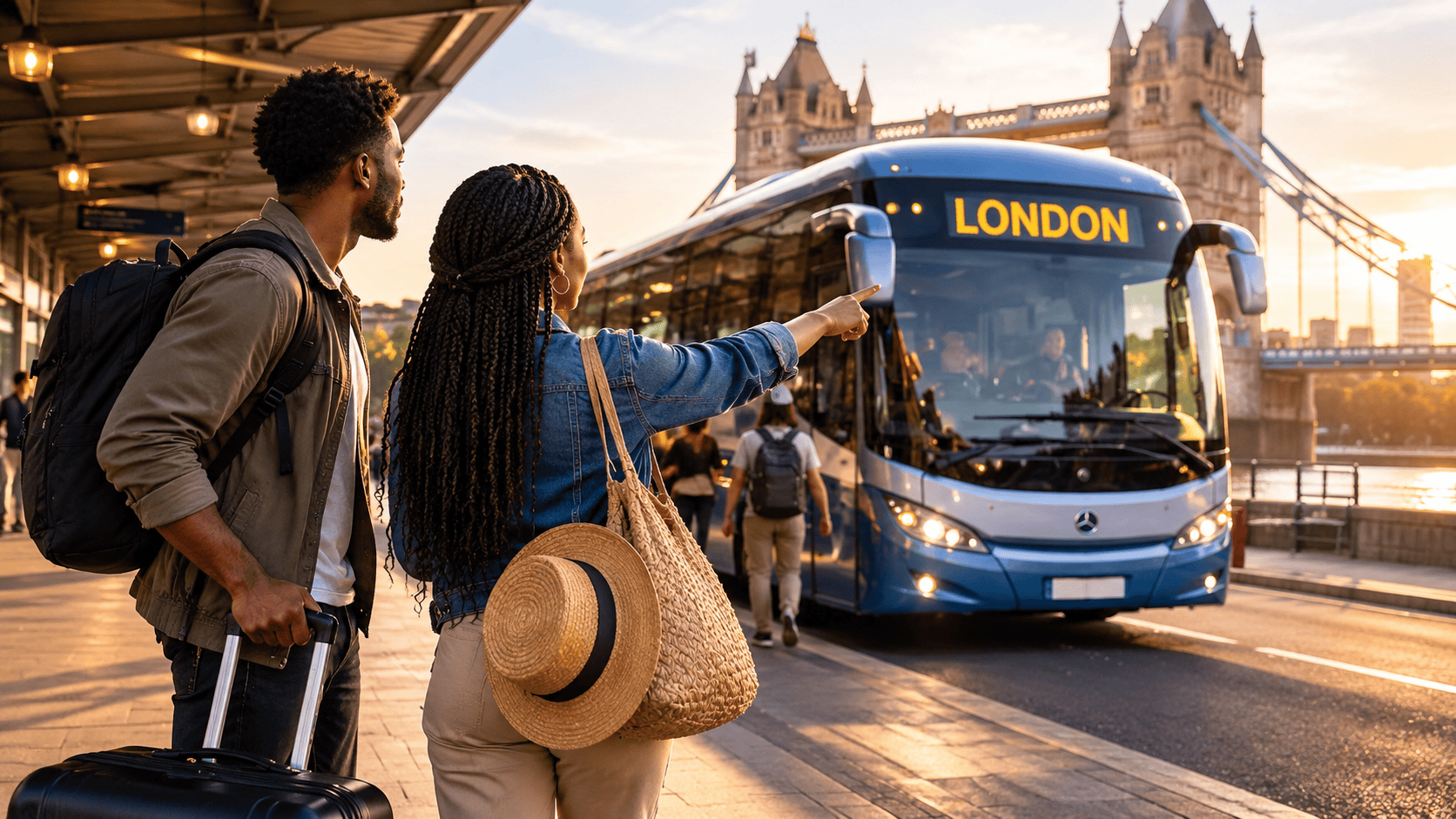
What Nigeria could unlock if transportation were treated as an integrated economic system.
I was on a night bus to Loughborough when I met a Nigerian professor from Loughborough University. He was also travelling to Loughborough, and as Nigerians often do when they meet outside the country, our conversation quickly found its way back home. We talked about Nigeria, its infrastructure and the things that continue to make movement across the country more difficult than it should be.
At some point, the conversation turned to transportation. He asked how Nigeria could invest more deliberately in transportation and build a system capable of connecting its cities, towns, villages, businesses and people. It was a simple question, but sitting on that bus made me think about transportation differently.
My immediate response was electricity. It is difficult to imagine a modern transportation system without reliable power, particularly when we think beyond roads and buses to railways, terminals, logistics centres, signalling systems and other infrastructure. But the more I thought about it, the more I realised that electricity and transportation should not necessarily be treated as separate problems to be solved one after another. They are interconnected parts of the same economic system.
When Movement Becomes Economic Infrastructure
A road is infrastructure. A railway is infrastructure. A terminal is infrastructure. But when they work together, they become an economic system.
This is where transportation becomes much bigger than the business of moving passengers from one location to another. Its real value may not be the money collected from fares, tolls or freight. It may be the economic activity that becomes possible because people, goods, capital and ideas can move more efficiently.
Nigeria’s own data shows that transportation is already a significant economic activity. The National Bureau of Statistics reported that the Transportation and Storage sector grew by 14.08 per cent in real terms in the first quarter of 2025, contributing 0.99 per cent to real GDP and 1.51 per cent to nominal GDP. The sector covers road, rail and pipelines, water transport, air transport, transport services, and post and courier services.
The bigger question is what happens when these activities are deliberately connected.
Connecting the Places Where Nigeria Produces
Rural development is an important part of that conversation. A good transportation system should not end at the major city. Roads should connect villages to towns, towns to regional centres and regional centres to major commercial corridors. When that happens, economic activity has the possibility of spreading beyond the largest urban centres.
There is evidence that better rural connectivity can have direct economic consequences. The World Bank says Nigeria’s Rural Access and Mobility Project brought 1.5 million people within two kilometres of an all-season road, improving access to markets and services and enabling farmers to sell their produce at higher prices. The project also contributed to a 31 per cent increase in the volume of agricultural produce transported.
Imagine, then, a future in which someone in Ondo State could reliably reach Lagos within two hours and return the same day. That would not simply mean a shorter journey. It could change where people live, where businesses locate, where farmers sell their produce, where workers find opportunities and how frequently money moves between regions. The distance between two places would still exist, but its economic meaning would change.
The same logic applies at the other end of the economic chain. In September 2026, Ogun State and DP World signed memoranda of understanding for the proposed Gateway Deep Seaport and a 10,000-hectare Blue Marine Special Economic Zone. The agreements envisage an initial investment of more than $7 billion and more than 50,000 direct jobs at full development. The proposed projects are also being linked to road, rail and power connectivity and wider industrial and logistics development.
The significance is not simply that Nigeria may have another port. It is the idea of connecting a port with an industrial zone and the infrastructure required to move goods between factories, markets and international trade routes. A port on its own moves cargo. A port connected to roads, rail, power, factories and logistics can become part of an economic corridor.
From Transport Business to Transport System
This is also where Nigeria needs to rethink how transportation itself is governed. Transportation should not be treated simply as motor parks, routes, buses and local businesses. Nor should the management of movement depend excessively on informal structures or political influence. The federal, state and local governments have a responsibility to treat transportation as a professional economic sector requiring planning, regulation, coordination and long-term investment.
This does not mean dismissing the millions of people whose livelihoods currently depend on informal transportation. It means recognising that the system itself has to evolve. At the 19th National Council on Transportation in September 2026, the Federal Government made integrated transportation the central theme, advocating stronger connections between road, rail, air and water transportation, lower logistics costs, professional capacity and stronger transport planning.
That shift in thinking matters. Managing transportation in a modern economy requires people who understand logistics, urban planning, infrastructure, technology, economics and regional development. It requires institutions capable of looking at the entire network rather than allowing each mode of transportation to operate as an isolated activity.
But infrastructure alone will not create this transformation. Roads can be built and poorly maintained. Railways can operate below capacity. Terminals can become disconnected from the communities and industries they are supposed to serve. Transportation therefore has to work alongside electricity, security, maintenance, land-use planning, financing, industrial policy and effective institutions.
The Economy of Connection
Perhaps that is what stayed with me after the conversation on that night bus. The question was not really about buses, trains or roads. It was about what Nigeria could unlock if movement stopped being treated as an isolated service and became part of the country’s economic architecture.
When a farmer can reach a market, a worker can reach a job, a manufacturer can reach a port, a village can reach a town and a town can reach a city, transportation is no longer simply carrying people and goods.
It is carrying the economy.