

TCMP
A simple thank you can make someone’s day. For millions of workers who serve the public daily, those two words offer encouragement, recognition and a sense that their efforts are appreciated.
However, appreciation alone does not pay the bills.
Research by Street Cover, published in October 2026, has drawn attention to an interesting contrast between the professions people reportedly thank most frequently in the United Kingdom and the earnings of workers in those occupations.
According to the research, shop and checkout staff emerged as the most thanked profession, recording a thank-you score of 67 out of 100. Their reported average full-time annual pay, however, stands at approximately £25,100, which Street Cover says is 36 per cent below the typical UK worker.
Waiting staff ranked second, with a score of 39 and annual earnings of approximately £22,900. Taxi and minicab drivers followed with a score of 26, earning approximately £26,800 annually.
Hairdressers and barbers recorded a score of 24, while delivery drivers scored 19. Their reported annual earnings were £24,300 and £27,900 respectively.
The contrast becomes particularly interesting when these figures are considered alongside the earnings of some other professions included in the research.
Doctors and surgeons, for example, recorded a thank-you score of 11, with reported average annual earnings of approximately £78,800. Train staff scored seven, with earnings of £46,100, while postal workers scored eight and earned approximately £31,700.
The figures at a glance
The following table presents Street Cover’s reported thank-you scores alongside annual full-time earnings and the pay comparisons supplied in its research.
| Profession | Thank-you score | Annual pay | Difference from typical UK worker |
| Shop and checkout staff | 67 | £25,100 | 36% below |
| Waiting staff | 39 | £22,900 | 41% below |
| Taxi/minicab drivers | 26 | £26,800 | 31% below |
| Hairdressers/barbers | 24 | £24,300 | 38% below |
| Delivery drivers | 19 | £27,900 | 29% below |
| Doctors/surgeons | 11 | £78,800 | 102% above |
| Coffee shop/fast food staff | 8 | £21,600 | 45% below |
| Postal workers | 8 | £31,700 | 19% below |
| Train staff | 7 | £46,100 | 18% above |
| Bar staff | 5 | £23,200 | 41% below |
Source: Street Cover research, October 2026. Figures and comparisons are reproduced as supplied by the organisation.
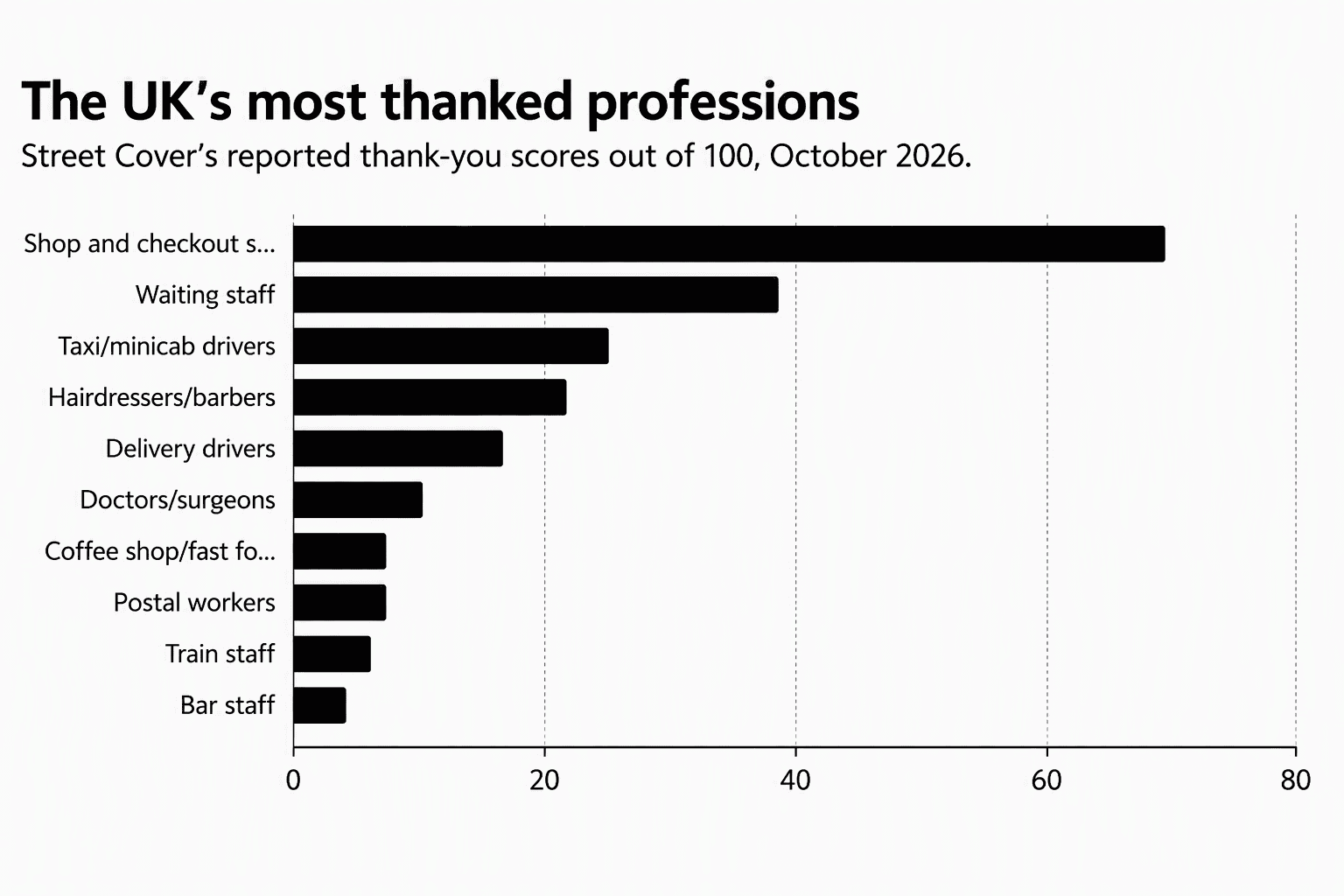
The most thanked are not necessarily the best paid
The figures reveal a striking pattern. Several professions receiving the highest thank-you scores are also among those earning considerably less than the typical UK worker, according to Street Cover.
Shop and checkout staff provide the clearest example. They lead the ranking with a score of 67, while their reported annual earnings stand at £25,100.
Waiting staff present a similar picture. They rank second in public appreciation, with reported annual earnings of £22,900, placing them 41 per cent below the typical UK worker.
At the other end of the scale, doctors and surgeons earn significantly more, although their thank-you score is considerably lower.
This raises an important question: does the frequency with which people express gratitude reflect the financial and social value attached to a profession?
Not necessarily.
Why do everyday service workers receive more thanks?
One possible explanation lies in the nature of the work itself.
Shop assistants, waiting staff, delivery drivers, taxi operators and other customer-facing workers interact directly with members of the public throughout their working day. These interactions create frequent opportunities for people to say thank you.
A customer collecting groceries, receiving a meal, taking a taxi or accepting a delivery is likely to have a direct encounter with the worker providing the service.
By comparison, some highly skilled professionals perform critical duties without experiencing the same level of routine public interaction.
The distinction is important. Being thanked frequently does not necessarily mean a profession is more valuable, more respected or better rewarded. It may simply mean that the nature of the work creates more opportunities for everyday expressions of gratitude.
Appreciation versus fair remuneration
The figures also invite a wider discussion about the relationship between appreciation and earnings.
Workers in retail, hospitality, transport and delivery services perform essential functions that support daily economic and social life. Several occupations identified among the most frequently thanked also appear towards the lower end of the reported earnings scale.
There is nothing wrong with appreciating workers through kind words, courtesy or tips. Indeed, a respectful society should encourage all three.
However, gratitude should not become a substitute for fair remuneration, decent working conditions and employment security.
A worker should not have to depend on the generosity of customers to make an inadequate wage more manageable.
This is particularly relevant in the hospitality sector, where tipping can form part of the discussion about staff income. Street Cover’s Head of Street Cover, Al Taylor, highlights the importance of customer appreciation and the UK’s tipping framework.
The broader principle remains that tips and expressions of gratitude should complement fair pay, not replace an employer’s responsibility to compensate workers properly.
The bus driver question
Street Cover’s accompanying material also states that bus drivers receive thanks from 93 in every 100 people. Although bus drivers do not appear in the supplied top ten table, the figure adds another dimension to the organisation’s findings about public appreciation for everyday service workers.
It reinforces the central theme of the research: workers whose jobs involve regular public contact often occupy a visible place in people’s daily lives.
What should we take away from these findings?
Street Cover says its research analysed nearly 1,400 posts across 11 UK online forum threads, counting each contributor once per job mentioned.
The findings should therefore be understood within the context of the methodology described by the organisation. They offer an indication of how contributors discussed and recognised different professions, rather than a definitive measure of the views of the entire British population.
That context does not make the findings less interesting. It helps readers understand what the figures can reasonably tell us.
Ultimately, the significance of this research extends beyond identifying the most thanked professions.
It offers an opportunity to reflect on how society recognises the people whose daily contributions often go unnoticed. From the shop assistant serving customers to the delivery driver navigating busy roads, these workers help sustain the routines on which individuals, families and businesses depend.
They deserve courtesy and appreciation. They also deserve fair wages, safe workplaces, respect and opportunities for economic advancement.
Perhaps the more important question is not simply who receives the most thank yous, but whether the people we appreciate are receiving the recognition they deserve in practical terms.
A thank you is good. Respect is better. Fair pay is essential.
TCMP’s position is clear: public appreciation should be accompanied by meaningful economic recognition. Dignity of labour must be reflected not only in what we say to workers, but also in how we treat and reward them.
Credit: https://www.streetcover.co.uk