Part 1: The Rise of the Demi-Gods
David Ola
The Man Who Became a Mediator
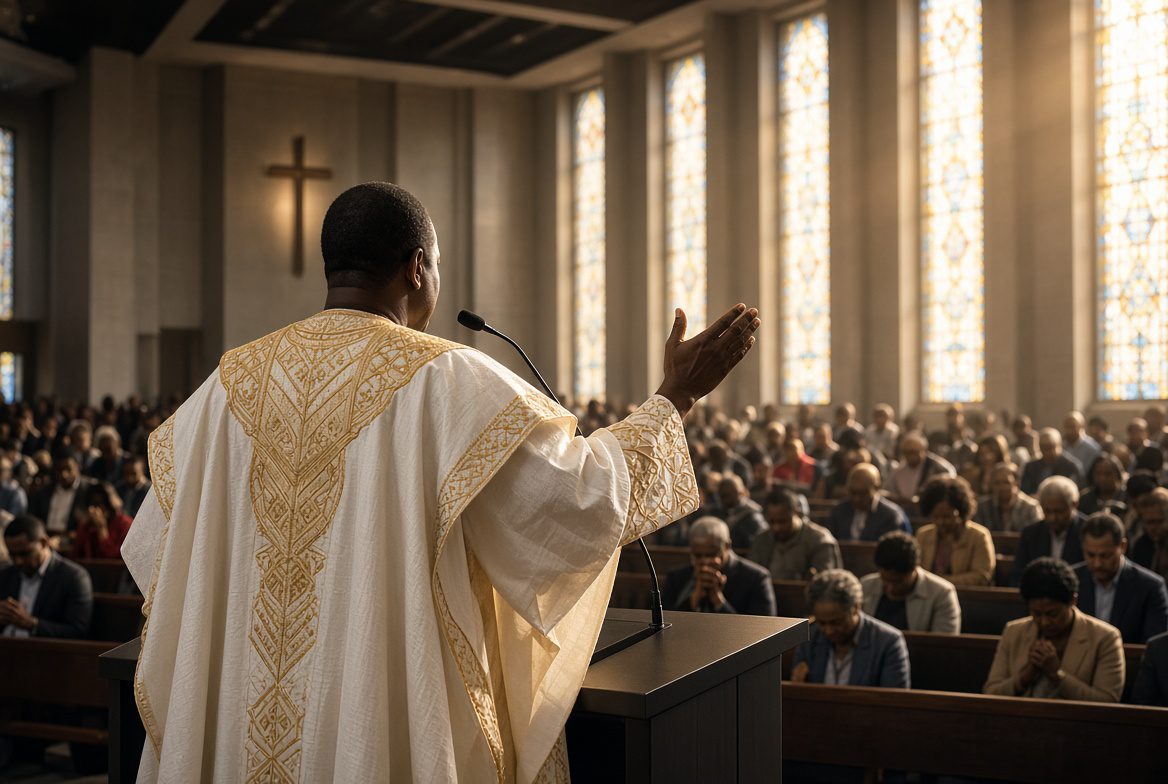
The Nigerian pastor walks into the auditorium, and thousands rise. Hands stretch towards him, not merely in greeting, but almost in worship. “Daddy.” “Father.” “Papa.” Whether in Lagos, Accra, Harare or Johannesburg, the scene has become emblematic of what critics describe as a dangerous theological drift within sections of African Christianity.
Church leaders, once understood primarily as shepherds, teachers and servants, have in some settings been elevated into spiritual authorities whose words are treated almost as divine pronouncements. The concept of the “spiritual father” has moved far beyond the biblical metaphor of discipleship and mentorship, becoming, in some churches, a system of control, manipulation and spiritual dependency that risks distorting the gospel itself.
This is not an attack on pastoral leadership. It is a cry for reformation.
When Mentorship Becomes Idolatry
Do we even need a “spiritual father”? Biblically, the answer is nuanced. Paul described himself as a father to believers he had brought to faith, saying, “For though you have countless guides in Christ, you do not have many fathers. For I became your father in Christ Jesus through the gospel” (1 Corinthians 4:15). He also described Timothy as his “true child in the faith” (1 Timothy 1:2).
Spiritual mentorship is therefore biblical. But Paul did not present himself as an absolute authority or a necessary intermediary between believers and God. His ministry pointed people towards Christ.
The modern spiritual father ideology, particularly in some African Pentecostal and Charismatic settings, has stretched this metaphor to breaking point. When a mentor becomes someone, whose approval is required before a believer can make important decisions, and disagreement is treated as rebellion against God, mentorship has crossed into control.
“Call No Man Father”
Jesus’ warning in Matthew 23:8-10 cuts directly into this question: “You are not to be called Rabbi… And call no man your father on earth, for you have one Father, who is in heaven.”
The context matters. Jesus was confronting religious leaders who loved titles that elevated them above others. His concern was not biological fatherhood or ordinary respect, but the elevation of human religious authority.
Jesus immediately offered another model: “The greatest among you shall be your servant” (Matthew 23:11). Authority in the kingdom of God was not intended to become an instrument of domination.
The question, therefore, is simple: Where does legitimate spiritual mentorship end, and where does human control begin?
The African Context
Why has this ideology taken such deep root in parts of Africa? One possible explanation lies in the interaction between Christianity and African traditional religious worldviews. Across different African societies, concepts of ancestors, elders, spiritual authority and mediation have historically played important roles. Africa is culturally diverse, so these traditions cannot be reduced to one single worldview, but they provide an important context for examining contemporary spiritual authority.
Has the modern “spiritual father”, in some African Christian settings, inherited elements of the traditional patriarchal role associated with protection, authority and mediation?
That question deserves serious theological and anthropological examination.
When a living church leader is treated as a patriarch whose pronouncements carry extraordinary spiritual authority, whose blessing is considered essential and whose displeasure is feared, the relationship has moved beyond ordinary Christian mentorship. Church members can begin fighting more vigorously for their pastor than for the gospel, while denominational loyalty eclipses loyalty to Christ.
From Shepherds to “Men of God”
The elevation of the spiritual father has also transformed pastoral identity in some settings. Church leaders are no longer seen primarily as teachers and shepherds. They can become, in the eyes of followers, men with extraordinary access to divine power whose “anointing” supposedly separates them from ordinary believers.
Yet the New Testament teaches believers to approach God through Christ and to live by the Holy Spirit. The Spirit is not presented as the exclusive possession of pastors, bishops, apostles or General Overseers.
When members are taught that they cannot hear from God without their pastor’s approval, cannot experience breakthrough without their spiritual father’s prayer, or cannot receive miracles because only the “man of God” has the anointing, spiritual leadership has become spiritual dependency.
That is where clericalism and potential spiritual abuse must be confronted.
The Denial of the Priesthood of All Believers
The New Testament doctrine of the priesthood of all believers, expressed in 1 Peter 2:9, is one of the most liberating truths of Christianity. Every believer has access to God through Christ, who is described as the sole mediator between God and humanity (1 Timothy 2:5).
A system that places a human figure between the believer and Christ risks undermining that truth. Church members can become consumers of spiritual goods, dependent on a religious personality for prayer, prophecy, breakthrough and divine favour.
Gary S. Maxey and Peter Ozodo examine related concerns in The Seduction of the Nigerian Church, particularly the influence of traditional religious ideas and other trends they argue have distorted aspects of Nigerian Christianity.
The focus shifts from salvation and grace to loyalty and performance. The gospel becomes a transaction rather than a transformation.
Religion or Grace?
Perhaps every African Christian must ask: Do I have religion, denomination, church or grace?
Belonging to a church or denomination does not, by itself, constitute salvation. The New Testament places salvation in God’s grace through faith in Jesus Christ.
This distinction is captured in a famous story attributed to John Wesley. Published in The British Friend in 1863 as “John Wesley’s Dream”, the story describes Wesley visiting the gates of hell and heaven and discovering that members of different denominations were represented among those in hell, while those in heaven were simply described as “Christians.”
The story has been used to emphasise grace and personal faith over denominational identity. Its publication is traceable, although its attribution to an actual dream experienced by Wesley should be treated with caution.
The question remains: What do you have, religion, denomination, church or grace?
A Crisis of Dependency
The demand for absolute loyalty is perhaps the most insidious aspect of the spiritual father phenomenon. In some church environments, those who question authority are labelled rebellious, while those who leave are warned about spiritual consequences.
Ghanaian Archbishop Nicholas Duncan-Williams has publicly recounted a crisis involving his spiritual father, the late Archbishop Benson Idahosa. According to Duncan-Williams, Idahosa withdrew his “covering” from him, after which he experienced serious difficulties. Duncan-Williams later sought reconciliation and pleaded for mercy. He recalled Idahosa responding, “Satan, this fight is between me and my son. Stay out.”
There is wisdom in reconciliation and honouring those who have invested in one’s spiritual development. But the account also raises a deeper theological question: Can a human spiritual father possess authority over another believer’s destiny, or does that authority belong to God alone?
The Gospel of Freedom
The gospel of Jesus Christ establishes one Father, God, and one Mediator between God and humanity, Jesus Christ. Believers are adopted into God’s family and called to live as sons and daughters with direct access to the Father through the Spirit.
The way forward is not to multiply spiritual fathers, but to raise spiritual maturity. Leaders should nurture, guide and shepherd, but never replace the Fatherhood of God.
Churches must return to Scripture, embrace the priesthood of all believers, restore servant leadership and encourage mentorship without control. Believers should seek mentors who point them to Christ, welcome accountability and help them become spiritually mature rather than permanently dependent.
Church members must also stop treating the defence of pastors, General Overseers or denominational heads as a spiritual obligation. God is able to defend His Church and those He has called.
The question confronting African Christianity is not whether pastors should be respected. They should. The question is whether respect has been allowed to become submission to a human authority that belongs to God alone.
That is the line the church must recover.
Are we following Christ, or have we quietly learned to follow the man who claims to represent Him?
David Ola is a digital media broadcaster, African storyteller and research scholar with over a decade of experience in journalism, strategic communication, academic mentorship and chaplaincy. A writer and analyst, he combines media practice with research rigour to craft narratives that inform and inspire. His work spans digital storytelling, broadcast media, development communication and evidence-based journalism.